
WRITER’S NOTE: Though the following isn’t related to travel, it touches on some aspects of my development as a writer, sometime artist, creative processes, and a few life lessons I’ve held onto over the years.
I’ve previously written about one of my major writing influences, but lately I’ve been gravitating toward the significant ones I knew personally. When I think back about who made an impact on me as a teen and young adult (my parents and family are a given), it always comes back to a handful of teachers and professors.
But like most of my writings, a little context is needed.
It’s Not “If” You Go to College
Back in high school, the district I was in took college applications VERY SERIOUSLY. In an area chocked full of power mongers, deal makers, and status symbol sporting uber professionals, expectations for every graduating class were far higher than landing a starter retail job and comparing notes at the 10 year high school reunion. Oh no, for Northern Virginia (and its proximity to the make-or-break career machine called Washington, DC), you made something of yourself or brought eternal shame to your family like a Euripidean hero forsaken by the gods of suburbia.
Fairly common for the area’s high schools, mine hosted a “career center” run by our literal next-door neighbor. The center was packed with literature on colleges and universities. Pennants from the big schools hung from the ceiling like an oppressive, conformance-demanding garland decoration, and there was barely any room to sit from all of the bookshelves lining the walls. Back then, the school’s mindset wasn’t if you applied to college, but which one you applied to. At the time, my school district was considered one of the top ones in the country, and among its coveted success metrics was how many students applied to and were accepted at an institution of higher learning. I remember one class session in the career center where a student dared scholastic damnation with the abominable term “trade school,” resulting in what can best be described as the mother of all “clutch my pearls” reactions from our career counselor.
For my parents, going to college was less of a choice and more of a heavily one-sided mutual agreement that I would give it a try.1 We made a few trips to various schools in and out of the state to get a feel for what I liked or would be a good match. We even toured West Point (my Dad’s alma mater) and the Naval Academy (for the sake of seeing it…obviously he leaned toward Army). The fact is I wasn’t military material and my parents weren’t the type to force that life on me (I still remember one conversation where my Dad reasoned that having seen what a military career is like, did I want it for myself). In fact, my parents have been wonderful about me hacking out my own path through life, though they’re never shy of leaning on me a little if they felt I needed guidance toward better opportunities or avoiding bad decisions (though I made few anyway). The added complication was I’m not a born athlete by any stretch of the imagination, and while my grades were a little above average, they weren’t competitive enough for a military academy.
Needless to say, I decided to remain a civilian and look at traditional colleges and universities.
As I’ve described in other posts, my circle of friends was dangerously similar to the gang on The Big Bang Theory, a group of guys (and few girls) with a shared interest in science, science fiction, fantasy, board games, comic books, role playing games, and laser tag. We were the kids sitting in the back of the library arguing over the latest episodes of Star Trek: The Next Generation or going over notes for our next weekly session of Dungeons & Dragons (every Friday evening, like clockwork and plenty of soda and Domino’s pizza). Given our group and bond, the expectation was my pursuing a science-related major.

However, that wasn’t the case.
Even from an early age, I always showed some talent for and a strong interest in art and creativity. I lived for arts and crafts in grade school, and began filling countless sketchbooks in middle school. By high school, I generated a sizeable stack of well-worn sketchbooks and was collecting comic books via weekly visits to a now long-gone shop called Time Travelers (there are several businesses with that name or something close to it, but I don’t know if any of them are related to this one). By then, I was studying every line and curve by my favorite comic book artists, a fascination that I knew rankled my parents, but it was my passion with dreams of professionally drawing those same heroes and villains someday. I was also trying my hand at some early story writing, but I was more comfortable with drawing at that time. I spent a lot of time drawing pictures of my friends RPG characters, with one or two still surviving to this day.
In college, one of my high school friends (a brilliantly creative writer) collaborated with me for a graphic novel based on our D&D adventures. We spent hours poring over his draft writing and my sketched-out ideas, trying to figure out what worked, what didn’t, and so many tweaked and revised drawings of what each character looked like. When it came time to start cranking out some pages, I wasn’t happy with the first few I attempted – they all lacked a certain dynamic look and energy I was aiming for. So, I took a break, then started over and created some pages that I was really proud of. Though his draft writing and my drawings were all that came of the effort.2
High School Whimsical
When I think back about my favorite high school classes and teachers, two immediately come to mind.
One is my freshman year World History teacher, a burly and bearded man who wonderfully made history more than dates and events, but relatable and in context with modern day. I still remember his very entertaining account of the War of the Roses, presenting it like a grand soap opera. Besides developing a healthy appreciation for the past (combined with my parents’ hobby of antique collecting – which I semi-loathed back then but appreciate now), he instilled a sense of perspective beyond the essence of “the more things change, the more they stay the same.” I learned that while we all have our issues and challenges, things could be a Hell of a lot worse and the past can still affect and influence the present. Sadly, he was forced to end his career shortly after I graduated. The rumor was he was a little too interested in certain students and was “invited” to retire. This wasn’t a huge stretch of the imagination given his notoriety for rearranging the class seating assignments, especially when the cheerleaders wore their short skirt uniforms (i.e., not so suspiciously reassigned to sit in the front of the class).
The other was my senior year, Spring semester English teacher. For Fall semester, the teacher was a kind but unimaginative woman who doggedly followed the etched-in-stone standard curriculum. She retired over the holidays and her replacement was a young, blonde, bubbly, fresh out of grad school woman that all the boys loved…for obvious reasons. She took a different path with us, where she thought the standard curriculum was boring. As a result, instead of focusing on ye olde standards of English lit, she threw the classic horror novels at us, including Dracula, Frankenstein, Dr. Jekyll and Mr. Hyde, and The Invisible Man. Granted, these choices wildly contrasted with her otherwise effervescent and pedestrian appearance, but it made for a fun class and I enjoyed reading books that I probably would’ve grabbed on my own at some point (and one was the basis for my master’s thesis).
I barely remember any of my other high school teachers. But looking back, I think the only ones I truly remember and despise were the gym coaches. Almost all of them were male, and each were what you’d expect – blunt, dismissive, and displayed a relentless suck-it-up/survival-of-the-fittest attitude toward athletics, fitness, and social dynamics. All of them enjoyed a weird habit of shoving their schedule/attendance notebooks down the back of their spandex shorts, and one nearly got fired for making far too many not-so-subtle proposals toward one of the female coaches (never mind that he was married and rumor had it she was a lesbian).
Collegiate Times
Needless to say, by the time I was accepted to and began studies at Virginia Tech, I was entering that next stage of life with a lot of doubt and no idea what I wanted to be or do. And fitting with my undefinable Generation X membership, I began college as an Undecided major, meaning my freshman year was wide open to feel out what subject area would be my calling (in my defense, I avoided stereotypically changing my major multiple times). Since I nearly flunked both Algebra classes in high school and barely survived my only required Calculus/Trig class in my first college semester, any prospective major involving math was definitely out of the question.3 This ruled out my other life-long passion of Astronomy since it focused heavily on Physics and the staggering amount of math involved (funny enough, my only steady college girlfriend was a Physics major and eventually President of the Astronomy Club).
Being Undecided, my freshman year was heavy on knocking out as many required electives and basic requirements as possible, including Basic Writing and World History 101. Initially, I thought History was my ideal field, but some nagging part of me said no. Even to this day, I enjoy reading history books (mainly ancient times), but something deep inside told me that wasn’t my path. At the same time, my Basic Writing professor was an engaging teacher who introduced us to a wide selection of short stories by contemporary writers, and I was starting to feel the draw of writing, reading other people’s writings, and writing about them. I also took a Basic Drawing/Studio Art 101 class with an otherwise forgettable professor who’s singular accomplishment was challenging me to create with more than just pencils and ink. I enjoyed the class, and seriously considered majoring in Art, but this was the VERY early days of computer-based graphic design, and didn’t like the program they were pushing.
By Spring semester, I added a couple of English classes to my schedule and knew that’s what I wanted to major in. I remember sitting in my then academic advisor’s office, going over the forms I needed to complete while he rolled his eyes about yet another young and hungry writer who wanted to be the voice of his generation. I was so excited about finally finding my direction that I ran back to my dorm room and called my parents. While they’re very open-minded people and willing to accept a lot from a son who has made some odd claims and questionable choices, they’re also practical people who saw my going to a tech school as the promise of building a solid life that contributed to society (i.e., tech skills mean you’ll always have a job somewhere). Their stunned silence when I announced that I registered as an English major was one of those moments in life that I’ll never forget.
Big Man from Chicago
Once I settled into the English program, I got to know the department’s motley crew of professors. One or two I learned to avoid like the plague for various reasons (both personal and in general), but was a little frustrated over missing opportunities to study under others like the great Nikki Giovanni. Eventually, I decided to add Art as a minor, which allowed me to keep developing my artistic skills and side step the graphic design program that I saw others struggling in.4 I also took a number of theater and drama classes, and enjoyed them so much that I seriously considered adding Theater as another minor. Unfortunately, I decided that too late, where the extra requirements would’ve added another semester to my studies…something my parents weren’t keen on.5
And here enters my favorite teacher of all time, my Life Drawing I professor, Dr. Robert Henry Graham, a man who definitely made his mark at my school.
He was a burly, giant of a man from Chicago who’s normal sing-song voice contrasted with his otherwise intimidating appearance, which included a hat and a scarf loosely hanging from his broad shoulders (no matter if hot or cold outside). Though he insisted on everyone calling him Robert, he frequently referred to everyone as “Mister” or “Miss” and their first name. I noticed that he never did that with me. Instead, I was always “Mister Wance” to him, and didn’t get why. After a month of class, I finally asked him why he did that, and he said that my name was wonderful and couldn’t see calling me anything else. On the other hand, I never got the nerve to call him Robert, so he was always Dr. Graham to me. I don’t know if he just manifested a special likeness for me or if it was just his charmingly capricious nature, but he never called me by my first name, ever (one of my classmates claimed that it means he liked me, but I don’t know if she meant that or was pulling my leg).
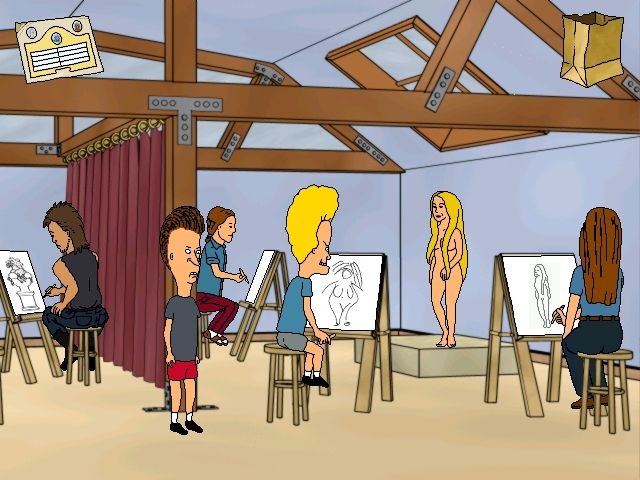
A Life Drawing class is the classic venue of artists standing at drawing desks, surrounding and focused on a nude model in the middle of a stage. Except for TV shows and movies, I never really experienced seeing naked people in front of me, and some in my dorm who saw my work often joked that I was an Art major to look at naked people. Dr. Graham put us through our paces – making us burn through giant pads of newsprint in seemingly endless exercises. Giving us anywhere from a few seconds to an hour to draw the model or models, changing media in mid-exercise, not looking at the paper, etc. It was a far cry from the idealized image of artists harmoniously observing and drawing a model posing like a classic Greek or Roman statue. He’d bring in all types of people to model for us – athletic, skinny, average, large, stocky, even a pregnant woman to teach us how proportions work. As we worked, he’d patrol the class, giving advice to whomever needed it or praise to others. The class’ two big tests involved studying the skeleton and major muscle groups, each culminating in an exam where we drew them out as an overlay of the model and label them from memory.
Dr. Graham wasn’t just teaching us about how to draw the human figure; he was giving us some big lessons on art and how to treat and regard people. That sign-song voice could surprisingly boom and carry across the room (and the entire art building, which was in the town’s old armory warehouse). But even when he was clearly angry or upset, his voice rarely rose above a stern inside voice. There was only one session where he showed real anger.
The cardinal rule in any art class is you never, ever disrespect the models. The act of disrobing in front of others isn’t always an easy thing – both physically and emotionally, and it was on us as the artists to respect their role in our work. Dr. Graham made it clear that all models are treated as professionals and respected as human beings – no ifs, ands, or buts.
Virginia Tech hosts a cadet corps that’s part of the ROTC program, and two of the cadets were in my class. Normally, they didn’t stand out very much, but were always at drawing desks next to each other. I didn’t get to know them very well, but I always felt a certain cockiness that felt grossly unwarranted. One evening, we hosted two very attractive female models, and though I was across the room from the cadets, their snickering was hard to ignore and not very complimentary given some of the looks from the other artists around them.
As Dr. Graham patrolled the class that evening, I noticed his wandering by the two cadets a few times without any hint of a reaction. At break time, he told everyone to be back in 10 minutes, but directed himself toward the two cadets, telling them to go home and that they were done. When they asked why, he replied that he heard their comments about the models and reminded everyone of how they should be treated. The cadets shrugged, packed up their things, and made for the door, boastfully telling everyone that they’d see us next week. That’s when Dr. Graham, in an unusually loud and angry voice said that they weren’t coming back – he was expelling them from the class. That lesson really stuck with me, though I’m big enough to admit that I’ve failed it more than once. But when I think about how I should treat people, both my parents’ teachings and his are the ones I always remind myself of.
I wanted to do my Life Drawing II class with Dr. Graham, but either his class conflicted with others I needed to take or it filled up too quickly, so I took the second course with another professor who provided her own valuable insights on art and my style, too (sadly, I don’t remember her name).6 Still, I always wanted to take more classes with Dr. Graham despite my own college career taking me in different directions. I would occasionally look him up online from time to time, seeing what work he was doing, and sadly discovered recently that he passed away a few years ago.
Literal Influences
While I was still an Undecided major, my academic advisor just happened to be an English professor, but once I choose English as my main course of study, I was reassigned one of my most entertaining professors – Tony Colaianne. He mainly taught the required standards, including my Shakespeare I class, but also taught classes on music lyrics, with a heavy emphasis on Bob Dylan. He was absolutely instrumental in helping guide me through my undergrad work and critical for when I decided to go after my master’s degree. He had an amazing sense of humor that I enjoyed and didn’t take the subject matter too seriously. I remember one class when we were reading Romeo and Juliet, and someone didn’t understand the joke in Act I, Scene I where Sampson is biting his thumb. Colaianne and I enjoyed our comparable Italian backgrounds, talking about the importance of dirty hand gestures and even demonstrating a few of them. Following his example, I submitted a paper arguing that Romeo and Juliet was actually a satire of other romantic tragedies of the time…I don’t remember what grade I received, but I remember him telling me he enjoyed reading it.
Although Virginia Tech tended to favor a more traditional curriculum, the Arts and Sciences department included a surprisingly wider range of course subjects than one might think. At the time, one professor in particular was the resident absurdist expert, Dr. Christine Kiebuzinska. I took her first class during my undergrad days and a similar graduate level class later. In her class, we read Brecht and Borowski, and an assortment of other writers who I can’t remember to this day. The two big works I do remember diving into were Brecht’s Mother Courage and Her Children and Borowski’s This Way for the Gas, Ladies and Gentlemen. These weren’t “happy happy joy joy” stories nor authors who were always liked by their audiences, but interesting to explore and discuss, and Dr. Kiebuzinska’s style involved a delightful way of talking about them that hooked your attention. She also didn’t suffer fools lightly, and ruthlessly but politely called out anyone as wrong or missing the point. Her gift to me was opening my mind to other genres and subject matter, which sometimes rewards me with finding books that vary from genuinely enjoying to utterly loathing.
For both classes, her signature group project was breaking up students into teams and developing their own absurdist plays, usually stealing (with her encouragement) whole passages and ideas from our assigned reading (especially with lots of non-linear storytelling). One of my groups included a drama major who insisted on singing a painfully depressing song from Mother Courage that became an exercise in picking battles by just letting them sing it rather than keep fighting against the idea (I remember Dr. Kiebuzinska telling us afterward that the song was the weakest part of our play).
In graduate school, I was very lucky to find an entire course on science fiction, also called “Speculative Fiction.” The interesting aspect of this class is it began with a brief overview of mythology and its elements (as a framework for where we get the need to tell stories with elements beyond or alien to our existence), then jumped ahead to the birth of modern SF literature with Mary Shelley’s Frankenstein. As the class progressed, we dipped into more contemporary writers such as H.G. Wells, Jules Verne, Ray Bradbury, Philip K. Dick, and Walter M. Miller. Here enters Dr. Len Hatfield, who knew science fiction and probably would’ve hung out in my high school crowd back in the day. He was a nerd and geek like my friends, and his class resonated accordingly. It’s one of the classes I always looked forward to the reading and attending.
I approached Dr. Hatfield when it was time to work on my master’s thesis, badly wanting to base my work on Frankenstein, a work I was now pretty familiar with from high school and his class (I wrote one of my class projects on it). He and I spent more than a few sessions going back and forth about the focus of my paper, initially having me read several modern variations of the book, including Frankenstein Unbound by Brian Aldiss and He, She, and It by Marge Piercy. Hatfield’s idea was for me to do a compare and contrast of themes among the novels, but I thought Aldiss’ book was bordering on ridiculous and was bored to tears by Piercy’s work. Despite his many attempts to steer me away from focusing only on Frankenstein (mainly because academia has pretty much beaten it to death), he eventually caved since I wasn’t planning on going after my doctorate and this was mainly a “check the box” requirement for my degree. Due to finishing up my other graduate requirements and needing to earn a living, I ended up taking a bit more time to finish my thesis, having gone through SO…MANY…REVISIONS until he finally signed off on it. I was never so relieved to be done with a project and college.7
Dishonorable Mentions
Just as with the good, I ran into a few bad influences, too.
As an English major, I got to know the faculty and staff pretty well as I wound my way through undergrad and graduate studies. I learned to avoid some professors at all costs, though I didn’t have a choice with one. He was a massively intelligent expert on medieval drama and poetry, but couldn’t be more in love with the sound of his own voice. Especially in graduate school, you’re expected to speak up, sharing insights and opinions, but his classes were mostly an exercise in shutting up and listening to him. On the other hand, as an almost stereotypical academic, the ins and outs of the real world sometimes escaped him. He was my pastoral poetry class professor, a class that I surprisingly enjoyed due to lots of mythical and magical tropes and themes. I’m not a big fan of poetry in general, but this class resonated with my interests in fantasy writing and role playing games.
I know it dates me a little, but the Internet was enjoying its huge explosion among the general public back then, with everyone’s dorm room blasting the god-awful harpy screech of modems and AOL’s all too familiar “WELCOME, YOU’VE GOT MAIL!” Because of this, the university pushed hard for every department to weave some kind of webpage building exercise into their classes. One week, that same blowhard professor gave us a long and winding review of how to build a basic webpage, using the concept of an introduction to pastoral poetry tropes as the model for his discussion. As he explained the tools and showed examples of how to use them while projecting his computer display on a large screen, he wanted to demonstrate these new, nifty things called “search engines.” As he chatted away, he typed in “fairies” and hit enter, bringing up a long list of related links. He clicked on one and continued talking to us while looking away from the screen. As he droned on, we did our best to stifle snickers or gasps as a gay porn site loaded on the giant screen. It took him a moment or two to realize something was very wrong, finally exclaiming “HOLY SHIT!” when he finally turned around and saw giant pictures of penises and what some like do with them. Fortunately, that was my very last course with him.
One of the more frustrating professors I dealt with was a former New York City drama critic who somehow became a Modern Drama professor. He was indescribably old, stunk of stale cigarettes, and mistook his New Yorker brand of cynicism for charm. The professor told us in the first class that it was his last semester before retiring, putting his “I don’t give a shit” attitude in perspective (and rendering our end of the class reviews pretty much worthless). He was so difficult to tolerate that most of my classmates would discuss ahead of time who would skip class, the idea being that we’d take turns and avoid everyone stepping out on the same days. However, he spent most of his career as a drinking buddy with many of the playwrights we were studying, so he REALLY knew them. As part of the class, we each needed to work on a semester-long project that culminated in a 25-page paper on a chosen or assigned playwright, and at some point, we needed to deliver a presentation on them, too.
Honestly, I don’t even remember which playwright I chose, but I spent the first third of the semester struggling over what to write. When I finally came up with a thesis idea, he admitted it was better than anything he thought up. While researching the playwright and his work, I quickly discovered that the professor wrote almost every article and book on the writer. In fact, I struggled to find anything not him that I could use to broaden and diversify my arguments with. When it was time for my presentation, I gave what he called an excellent overview of my ideas and progress, but stopped me when I quoted something that beautifully supported my arguments. He paused a moment, then looked at me and said something along the lines of “Oh my God, where the fuck did you find that quote? Who’s the idiot that came up with that piece of shit?” Of course, it was from one of his books, and though I struggled to maintain a ruse that I couldn’t recall and would follow up with him later, he insisted on knowing right then and there. Giving in to the horror of nowhere to run, I sheepishly pulled his book out of my bag, showing him the quote I marked with a stickie note. For a few silent moments that felt like an eternity, I wondered if I just flunked the class, but he just shrugged and said “Yeah, okay, whatever” and moved on. Oddly enough, I ended up getting one of my highest grades in his class. One of my high school friends who attended grad school with me found that professor’s CV years later, and I can honestly say that man built a long and distinguished academic career that I would never have guessed about back in college.
Finally, toward the end of my graduate studies, I took a class on early American essayists (including the likes of Ben Franklin, Thomas Jefferson, and Thomas Paine). It was a small class of six students, equally divided between men and women, and led by a woman professor who ran every class with the most extensive and organized set of notes I’ve ever seen. She facilitated very controlled and deliberate discussions, and clearly expressed her considerable irritation whenever someone managed to take the discussion in a direction she didn’t plan on. Early in the semester, she hosted a dinner at her house, intended to be a less formal discussion of whatever we were going over at the time. Her husband (also a professor) managed to piss her off by walking into the middle of our discussion with a case of beer, completely derailing my professor’s agenda, even if he was just trying to be a good host.
The thing I struggled with was my papers and exams in her class all came back as failing or barely passing. By midterms I was genuinely concerned of flunking the class, and thereby utterly torpedoing the minimal grade average I needed to get my degree. When my classmates and I compared notes, we discovered a definite trend of the women students receiving passing grades while the male students were barely surviving. I spent the second half the semester poring over research and revising every paper over and over to make them shine, only to get horrendous grades as a return on my academic investment.
My final exam was ridiculously tough, and adding insult to injury, she handed out our final projects with a huge F on mine. We were coming into our month-long winter break, so I went to her office and spent the next hour arguing for the opportunity to completely rewrite my paper in the hopes of earning a higher grade to pass the class. She was deadset against it, simply refusing every argument I made for the extra time. At one point she questioned how I even got into grad school, mistaking me for a first-year graduate student (and was shocked when I told her it was my next to last semester). Finally, I went for my last-ditch argument, and one that I took the precaution of documenting with my fellow classmates, pointing out how the grades in the class seemed to follow a definite trend based on gender, and that I needed to escalate the concern to the head of the English department (my then academic advisor suggested this since he knew her reputation). It was the only time the humorless and stoic woman showed any hint of fear, and grudgingly agreed. I spent the next few weeks using every spare moment researching and rewriting my paper, submitting it to her around Christmas. Just before I drove back to school, the professor emailed me saying I barely earned a B on the paper and managed to squeak by with a passing grade.
Whether majoring or minoring in Art, the program required students to choose a medium to focus on, and in my case, I chose one of the hardest – watercolors. Probably a result of my first art professor encouraging me to broaden my horizons in terms of skills and technique, I always loved the look of watercolor paintings and thought I could do something with the medium. I ended up taking three courses, all taught by the same professor who I wouldn’t call a bad influence, but he was certainly entertaining. I attended the courses with mostly the same classmates, including one guy who was ridiculously talented – you’d think you’re doing well, then peek at his work and question why you even bother trying. He and I became good friends because of our shared interest in comic books and we bonded over our dangerously similar senses of humor. One thing we both observed is our professor loved to lecture about any and everything (especially in line with his former hippie days), but usually about everyone’s art and why his was so much better (I went to one of his art shows and saw his studio, he was no Picasso). So, if we wanted to distract him from criticizing our efforts, we’d bring up some social or political subject and let him pontificate harmlessly on the subject until class ended (and effectively not bothering anyone).
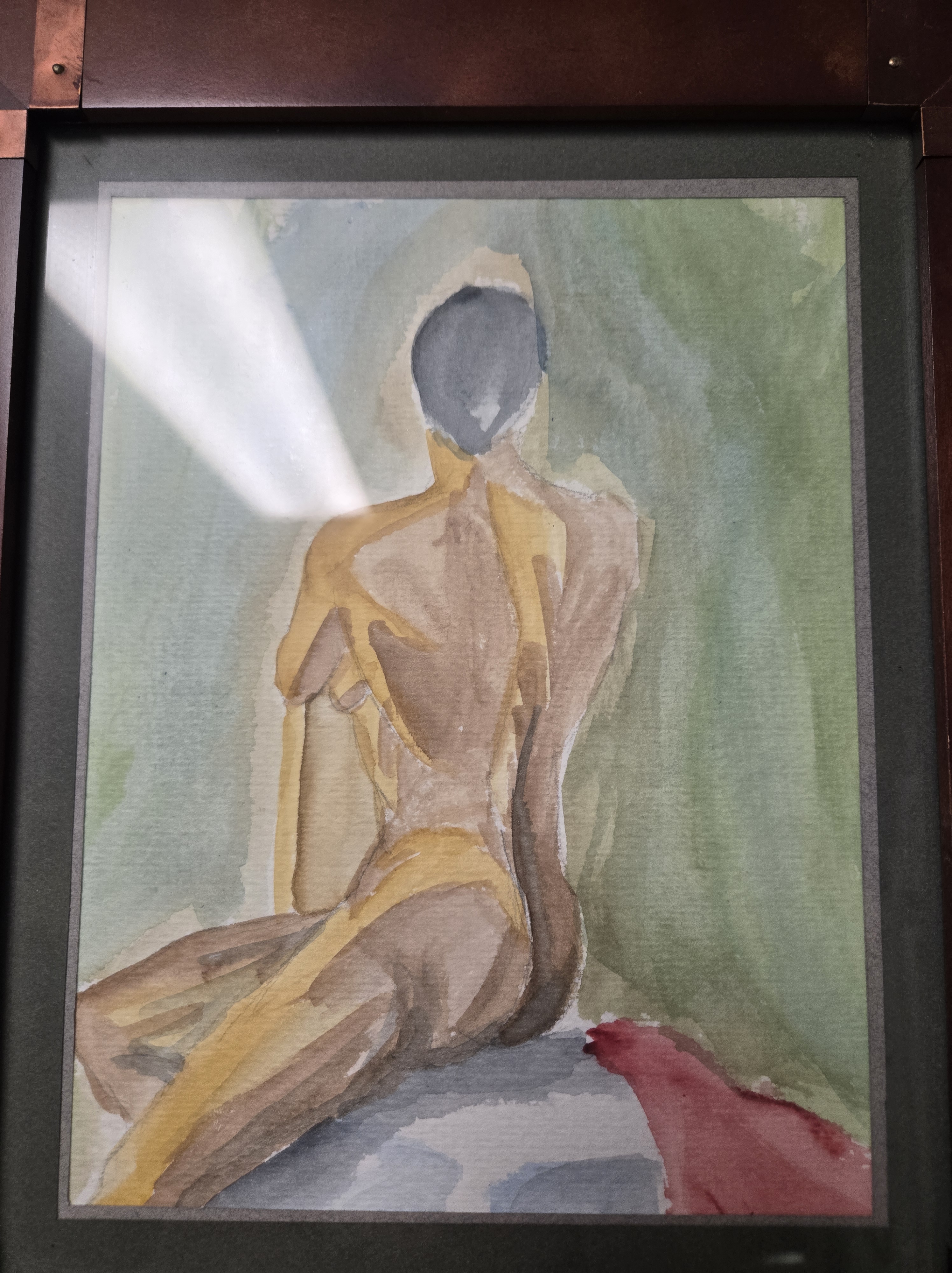
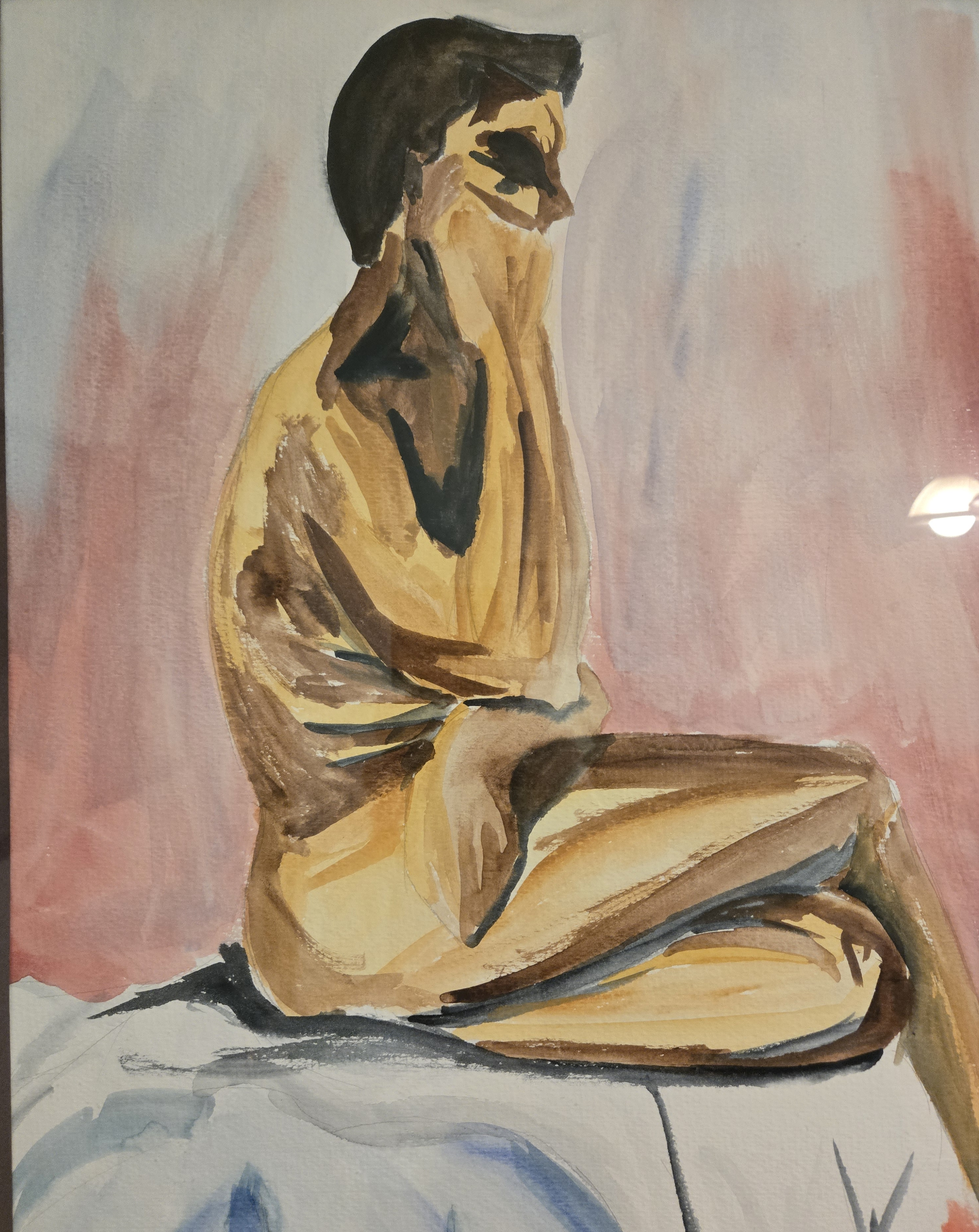
My few surviving watercolor paintings (same model in both).
Apologies for the glare, I couldn’t get a better angle.
Going way back, the only elementary school teacher I recall with complete clarity is from my fourth grade class, a woman I utterly loathe with every fiber of my being to this very day. This was while we were living in North Carolina, and she presented herself as God’s gift to education (a bold claim considering where we lived), gushed endlessly about North Carolina being the best place ever (it wasn’t), and insisted she sang just like Lorretta Lynn (she didn’t). She lived for applying the then state’s open-door policy on corporal punishment (i.e., spanking students with a wooden paddle – or “paddlings”), where I managed to satisfactorily piss her off the one time I received it, asking “was that it?” after she finished. A big part of that school year was her teaching North Carolina state history, and my class arguing against her proudly boasting about the town’s old courthouse (its only significant landmark), which was the unfortunate site of hangings and lynchings for those brought to the Americas against their will. My parents will tell you that my particular class probably needed a firm hand in terms of education and discipline, but I’d be lying if I said I didn’t spend nights back then staring at the ceiling, dreaming of all kinds of horrible things happening to her.
Final Thoughts
Looking back on what I wrote above, I’ve tried thinking about my more noteworthy school experiences, but I’m sure I’m missing a few. I badly want to dig out my old yearbooks (tucked away in a storage bin) and see what other long-forgotten memories pop up. But in terms of who made a lasting impression (for better or worse), what you see above are definitely the ones that always come to mind. I wish I could call the ones I adore mentors, but my time with them was too brief for that. Still, they and their lessons stayed with me all these years.
NOTES
1 Let me be clear on this point, there was no gun pointed at my head. I wanted to go to college, but if I decided on not wanting to go, well…that probably would’ve led to an interesting family conversation.
2 Sadly, due to other priorities (mainly school), my friend leaving the area, and eventually needing to earn a living, that graphic novel went the way of the dodo. Before he left to follow his own path of self-discovery, I bequeathed almost all of my graphic novel sketches and penciled-and-inked pages to him for safe keeping. Over time, they eventually disappeared, a victim of his many moves. My two biggest regrets as an artist and writer are that I didn’t hang on to more of my old sketch books/graphic novel work and my accidentally throwing away the old floppy disks containing my college work (undergrad papers, graduate projects, and my thesis). I thought I saved the files elsewhere, only to discover that I didn’t. I even tried every Virginia Tech resource I could find for any record of my thesis, but came up with nothing. Because she loves art and creativity like I do, and what I’m fairly certain is a case of compensating for my own lost work, I’ve gone to a lot of trouble to organize, store, and digitally scan every piece of my daughter’s art.
3 My high school struggles with Algebra I and II were truly monumental. My teacher for both classes was incredibly patient and helpful, giving me one-on-one tutoring and making me spend every possible afternoon after school at the math lab. By the mid-term exams, I was averaging near failing grades for both classes, but managed to pull out B level grades by the end. I was assigned the same teacher for Geometry, and the look on her face when I walked into class was pure shock. Though to her genuine surprise, I cruised through Geometry with flying colors since the subject appealed to my aptitude of abstract thinking/concepts and artistic leanings.
4 That same college girlfriend has a twin sister who also attended Virginia Tech as an Architecture major. I very briefly considered the idea of pursuing that program until I saw the many trials and tribulations her sister and fellow Architecture majors struggled with, including long and demanding projects, frequent all-nighters in the Architecture’s school work room (I still remember the sight of several desks having bunk beds built over them), and soul-crushing exams. To call it a grueling program that was notorious for weeding out students is putting things far too mildly.
5 Admittedly, one of my favorite tricks with my theater and drama classes was cannibalizing related papers I wrote for some of my English classes – this saved me a Hell of a lot of time and trouble. I figured it wasn’t plagiarism since I wrote the papers in the first place, and my theater and drama professors didn’t seem to notice. Considering how closely connected the English and Theater departments were, I’m genuinely surprised no one figured out what I was doing (or they didn’t care).
6 My college girlfriend and I broke up around the time I began my Life Drawing II class. Since she and I enjoyed mutual friends, we tried to keep things polite and friendly, though that was very short lived. One afternoon before art class and not long after the relationship ended, I accidentally discovered that she was already seeing someone new (her turtleneck slipped, betraying a rather generous collection of hickies adorning her neck). Needless to say, I didn’t take that very well and went to art class vibrating from a potent mix of young adult emotions (some justified, some not so much). The model for that night’s session was brand new and nervous about disrobing. She was sitting in a chair as the professor spoke with her about her anxiety with posing naked, when the professor paused and decided that the evening’s assignment was to draw the model while she sat. I was so worked up with emotional energy from the afternoon’s revelation that I pored over my drawing nonstop for the entire 3 hours. I didn’t stop for the bathroom or breaks, even when the professor asked if I wanted to take a moment (she was very intuitive and sensed that I was upset about something). That evening’s portrait hangs on my wall to this day as probably one of the better pieces I ever created (even if I do say so myself). One last note about my Life Drawing II professor, she found it in herself to tolerate my Patrick Nagel phase, which I enjoyed a little too much.
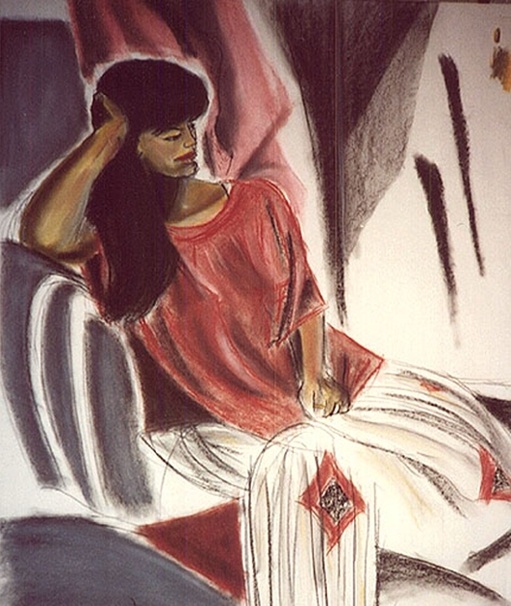
Conte crayon on plain white paper.
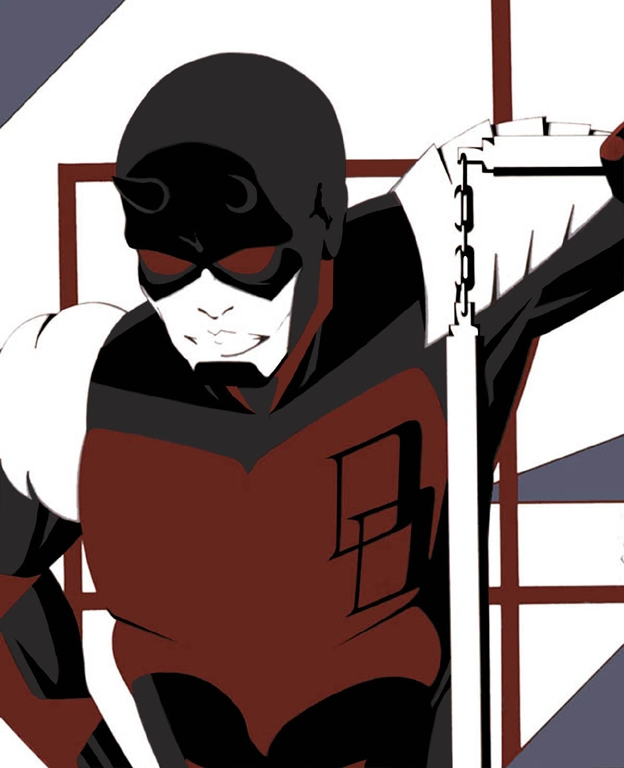
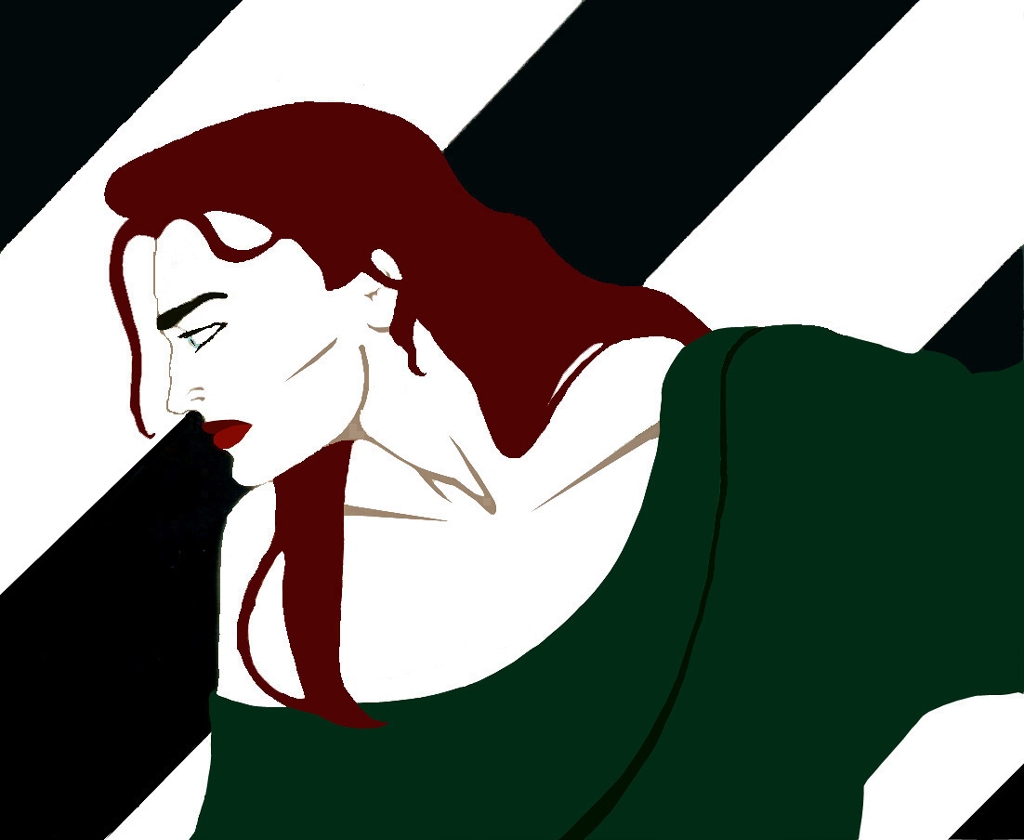
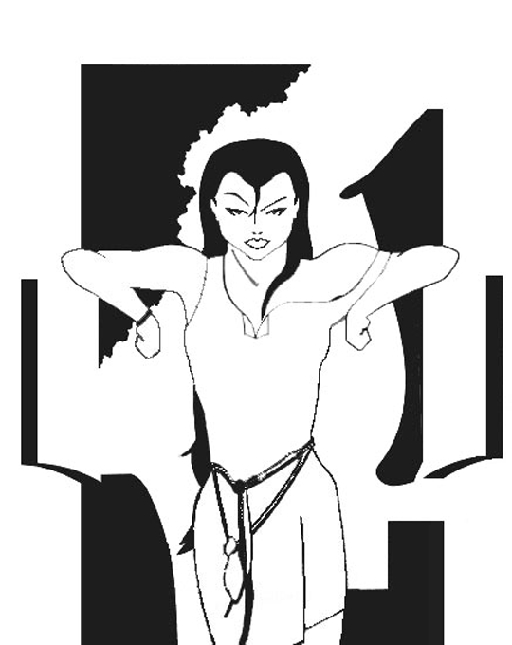
I always felt these turned out rather well, all things considered. I was one of the few who liked Daredevil’s newer (and briefly lived) look back in the 90s, the middle portrait was loosely based on a girl I was interested in at the time, and the last portrait is the only known piece left from the graphic novel work.
7 I love and encourage learning, and try to pass on to my daughter that there’s nothing more important in life than getting an education. However, institutions can be a true challenge. I once heard a pastor say “never let church get between you and God,” and I like to say “never let school get in the way of your education.”

